48.1351° N / 11.5820° E
An event happens once. The picture has to work anyway — even when there is no precedent for it.
The first job in Munich was cutting trailers. He took it not for the trailers but for the Flame — the machine where everything that looked like the future was being made. Two years later he was sitting at one.
Overview
Telling live events while they happen. Directing, editorial, camera, analysis — usually for an audience of millions.
01
Eight stops a season, world feed, broadcast globally. 390 km/h, ten metres above the ground. At the Air Race a schedule is a statement of intent — they fly when the weather lets them.
Editorial Director across several seasons, credited by name — responsible for the main product, the live show on the world feed, the signal that went out to every rights holder worldwide. After the race came the second use: the highlights show. Eight stops a season — Las Vegas, Lausitz, Rovinj, Ascot, Budapest, Spielberg, Fort Worth — plus recon flights, track films, pilot portraits, season reviews. Everything hung on the weather: flying at 390 km/h ten metres above the ground is only possible in conditions that allow it, and the entire schedule followed from that. A timetable fixed days in advance is, at the Air Race, a statement of intent.
02
Runs, distances, offside lines — calculated into the live picture, next to the pundit in the studio. Sammer, Wontorra, Beckenbauer. Seconds separate his sentence from the image.
With Piero — software originally developed by the BBC — a passage of play is taken apart live: runs, distances, offside lines, changes of perspective, calculated into the running picture. What gets analysed is not the image but the scene: what happened on the pitch, and why. I have been doing this since 2001 — Champions League, Bundesliga, the German ice hockey league, most recently the 2022 World Cup for MagentaTV, produced by Plazamedia, from the hybrid XR studio in Ismaning, not from Doha. A German tabloid called it the “World Cup studio on LSD”. Broadcasts watched by millions at the same time. I have also taught the analysis abroad, among other places in Saudi Arabia. I operate the software live, next to the pundit in the studio — over the years among others Matthias Sammer, Jörg Wontorra and Franz Beckenbauer. Seconds separate the pundit's sentence from the picture.
03
First a film about the aircraft. Then the follow-up commission: three cameras, two in Eurofighters, one in the A400M. The viewer switches aircraft mid-refuelling.
Two commissions, two films, both through Schwarzbild. First “Flying the Eurofighter”, 2018, shot in 360° in Albacete — the aircraft itself. Out of it came the follow-up: the air-to-air refuelling in 2019, in flight, with three cameras — two in Eurofighters, one in the A400M. The viewer moves between all three aircraft while the refuelling happens. One run, no second take, no influence on anything — and in 360° there is no spot where a camera would not be visible.
04
Monaco, Rome, Valencia, London, Riyadh. Plus Le Mans and the Hahnenkamm. Cameras in places where racing does not put them.
360° VR coverage for Formula E: Monaco, Rome, Valencia, London and Riyadh — five circuits in a single season, plus the 24 Hours of Le Mans and the Hahnenkamm downhill. Cameras in places where racing does not normally put them. Five years later, this series became the POV project at the Olympic Games.
05
Cameras in the athletes' goggles, LTE built into the slope. Livigno, two disciplines, an Olympic first. 34 men, 16 women. The hard limit is not picture quality — it is acceptance.
Cameras taped into the athletes' goggles, transmission over LTE — in Livigno in two disciplines, ski cross and snowboard cross, and with that for the first time at an Olympic Games. In ski cross alone, 34 men and 16 women were fitted. Behind it lay years of testing — a series that began in 2018 with the Volleyball Masters in Vienna. The hardest constraint is not picture quality but acceptance: fifty people racing for an Olympic medal, each wearing an unfamiliar component on their face. The network behind it was not a public one: a self-contained LTE network, built onto the slope for this broadcast alone, by Riedel.
Son of a sea captain, surf and sailing instructor at fifteen on Lake Mondsee. Today an offshore sailor and skipper — at the helm when it counts, and busy moving a sailing school into digital operation.
06
First paid job as a skipper: taking Louis Vuitton guests out to the race course on a fully electric foiling boat. Alongside, the competitors are doing 35 knots. A change of course is not a leisurely decision here.
My first paid job as a skipper. The task: bringing Louis Vuitton's senior guests out to the race course — aboard THE ICON, the fully electric foiling boat by BMW and Tyde. Thirteen metres, two 100 kW motors, eight passengers, up to 30 knots. In the same year the AC40 racing simulator was built at JOJO. You are not alone out there: the competitors move through the same water at 35 knots. At those speeds, a change of course is not a decision you make at leisure.
07
Three stages: live online teaching and a virtual studio. XRNAUT, the harbour-manoeuvring simulator, used weekly in class. And myJOJO — courses, community, AI tutor, live since September 2026.
Six years, three stages. Live online teaching and a virtual studio: in 2020 the teaching moved into live online studios, in 2023 a virtual studio was added — theory has been broadcast since then, not read aloud. XRNAUT, the harbour-manoeuvring simulator: in weekly use since 2022 — several hundred students have docked in it before doing so on a real boat; alongside it multiplayer VR sailing and, in 2024, the AC40 racing simulator. The interactive learning environment “myJOJO”: in operation — licence courses, skipper talks and the academy all run on it, together with a community, an AI tutor and weekly live Q&A sessions. Precisely what a self-study course does not have. All of it was built while the school kept running; nothing stayed a prototype.
The first exhibition of my own was in December 1998, under the name shiva01 — a year before the first paid job. Eighteen independent works since then, alongside the commissioned ones.
08
My own first exhibition, a year before the first paid job. Mixed media after a text by Geoffrey O’Brien on the disappearance of whatever carries knowledge.
Eleven paintings, acrylic on canvas, shown under the name shiva01 at SHAKESPEARE, Hubert-Sattlergasse 3 in Salzburg, 4–20 December 1998. Mixed media after a text by Geoffrey O’Brien on the disappearance of whatever carries knowledge. A span between old and new, analogue and digital — drawn before there were words for it.
09
“Orfeo ed Euridice” as a virtual opera in live operation. The premiere fell in the pandemic: 150 people in the house. Only a year later did all 500 displays run at once.
“Orfeo ed Euridice” as a virtual opera in live operation, for the Staatstheater Augsburg foundation. The system was designed for more than 500 synchronised headsets. The premiere fell during the pandemic: 150 people were allowed into the house. Only a year later did all 500 displays run at once.
10
Pioneer releases the DVJ — for the first time, picture can be played like sound. Scratched, looped, locked to the beat. No manual, no school for it. The first work without a precedent.
Four years of live visuals in clubs and at festivals — for Tom Novy, over sets by David Guetta, Swedish House Mafia, Sander Kleinenberg and Dave Seaman. Amsterdam, London, Vienna, Ibiza, Portugal, Moscow, Bucharest. The sponsor was Pioneer: the company had just released the DVJ, a CDJ for DVDs, along with a mixer that could mix video too. For the first time, picture could be played like sound — scratched, looped, locked to the beat, live. We were among the first to work with it, at a time when a handful of people worldwide had ever held the device. Three players and a mixer, 23,000 euros of equipment, for images in a club. There was no manual and no school for it. It is the first work in my CV for which no precedent existed. It was not the last.
11
Any rig would be in shot — so a dolly built from a converted wheelchair. Flat, silent, remote-controlled. DOK.fest Munich, second place at TechCrunch Berlin, shown at the Bavarian Academy of Fine Arts.
360° films stood still back then. There was no dolly, no crane, no track — any rig would have been in shot, because there is no behind-the-camera any more. “Fat Cap” was the first 360° documentary with a moving camera: shot with a drone and with a remote-controlled camera dolly we built from a converted electric wheelchair. The film screened at DOK.fest Munich and took second place at TechCrunch in Berlin. The wheelchair was not the cheap solution but the right one: low enough to disappear under the camera, precise enough for a move, and electric, therefore silent. In June 2018 Daniel Man and I showed the work at the Bavarian Academy of Fine Arts on Max-Joseph-Platz — at “i4c — The Magic in Virtual Reality”, a curated exhibition of immersive work, with Edgar Reitz on the panel. The question we put there: can VR preserve art and performance that by definition disappears?
Four invitations in a single year, from four directions: a research institute, a broadcaster, an academy of fine arts, a state government.
Broadcast by13th Street · arte · The Biography Channel · Das Vierte · Disney Channel · The History Channel · Kabel 1 · MBC · MGM · NBC Universal International · On Demand Deutschland · ORF · Premiere · ProSieben · Red Bull TV · Sat.1 · Servus TV · Sky Deutschland · Studio Universal · SyFy · TLC · ZDF
Brands and clientsAirbus · Amorim · A.T.U · Barber & Butcher · BayWa · Bayerische Staatstheater · Bernina · BMW · BMW Museum · Bosch · Condé Nast · Continental · Cosmopolitan · Disney · Doctor Babor · Dorling Kindersley · Douglas · Eckerle · Essex · Eurofighter · European Commission · Fresenius · Garmin · GE Germany · Greenpeace · Henkel · Kaufland · Microsoft · Nintendo · OSRAM · Österreichische Post · P&G · Peugeot · Pioneer DJ · Red Bull · Red Bull Air Race · Sinn Leffers · Staji · Superpaper · Tai · Tom Novy · Vernel · Volvo · Watercult · Westwing · Wick · Wöhrl · ZDNet
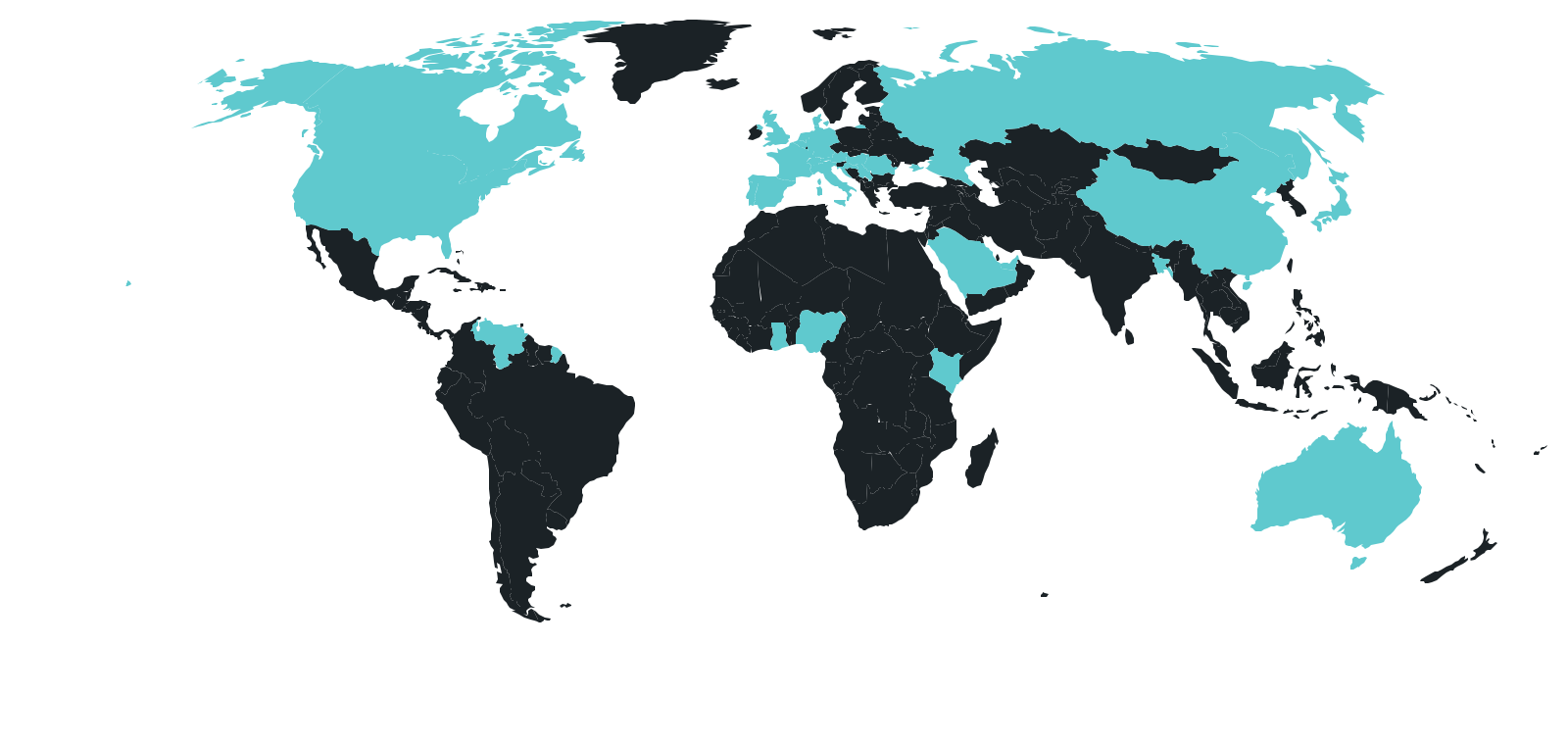
30 countries.
53 places.
The travelling did not start with sport but in clubs: Moscow, Bucharest, London, Amsterdam, Ibiza — ten years before the first Air Race. Then two months shooting across Nigeria, a commission of its own for the Nigerian ministry of petroleum and gas. Ghana, China and Australia were one commission: the Fresenius centenary films, four continents. Add Bangladesh, Kenya, Venezuela, Saudi Arabia, Japan, Barcelona.
He works where a thing has no finished form yet — on the dividing line between analogue and digital. That line does not sit still. It moves, and he has moved with it.
In 1996 he wrote a thesis in Salzburg on computer-aided interactive multimedia. Two years later he hung eleven paintings, acrylic on canvas, under the name shiva01, after a text about the disappearance of whatever carries knowledge. The show was called obsolete media. The first paid job came a year after that.
1999, Munich, cutting trailers at Seven Senses. He took it for the machine standing in the room: a Flame, where everything that looked like the future was being made.
The technology has changed since. The work has not.
In 2006 Pioneer released the DVJ — picture could be played like a record for the first time: scratched, looped, put on the beat. No manual, no school. In 2018 a 360° film stood still, because any rig would have been in frame; the dolly became a rebuilt wheelchair, flat enough to disappear under the camera. In 2020, 500 headsets ran in sync with an opera. In 2026 in Livigno, cameras were glued into the racers’ goggles and the LTE was built onto the slope.
Editing, graphics, real time, camera, 360°, interaction. Six crafts, none of which replaced another. They accumulated. The live scene analysis for football has run since 2001, alongside everything else.
He got there by plane, on a commission, with a return flight in the calendar. The travelling continues. Slower now, by boat.
Son of a captain, a sailing instructor on the Mondsee at fifteen, today an offshore sailor and skipper — and in the middle of moving a sailing school into digital operation: live online classes, a virtual studio, a harbour-manoeuvre simulator in the weekly timetable. What is taught in it is older than any electronic navigation: chart, compass, bearing, dead reckoning. Everything that works without power.
Low tech, taught with high tech.
Everyone sails with GPS and plotter. For as long as they work. At some point the power goes, and then what counts is not what the device could do, but what somebody has in their head.